- IAYT Approved· Advanced Professional Development
Anatomy, Physiology
& Biomechanics
A Complete Teaching Manual in Pranayama, Nadi Science, and Kumbhaka
for Yoga Therapy
A 15-hour clinical foundation course for certified yoga therapists. Deepen your anatomical knowledge, sharpen your assessment skills, and earn 15 CPD hours toward C-IAYT re-certification.
Course Fee
- 24 Contact Hours
- 6Learning Areas
- 24CPD Hours
- 24Clinical Protocols
— About This Course
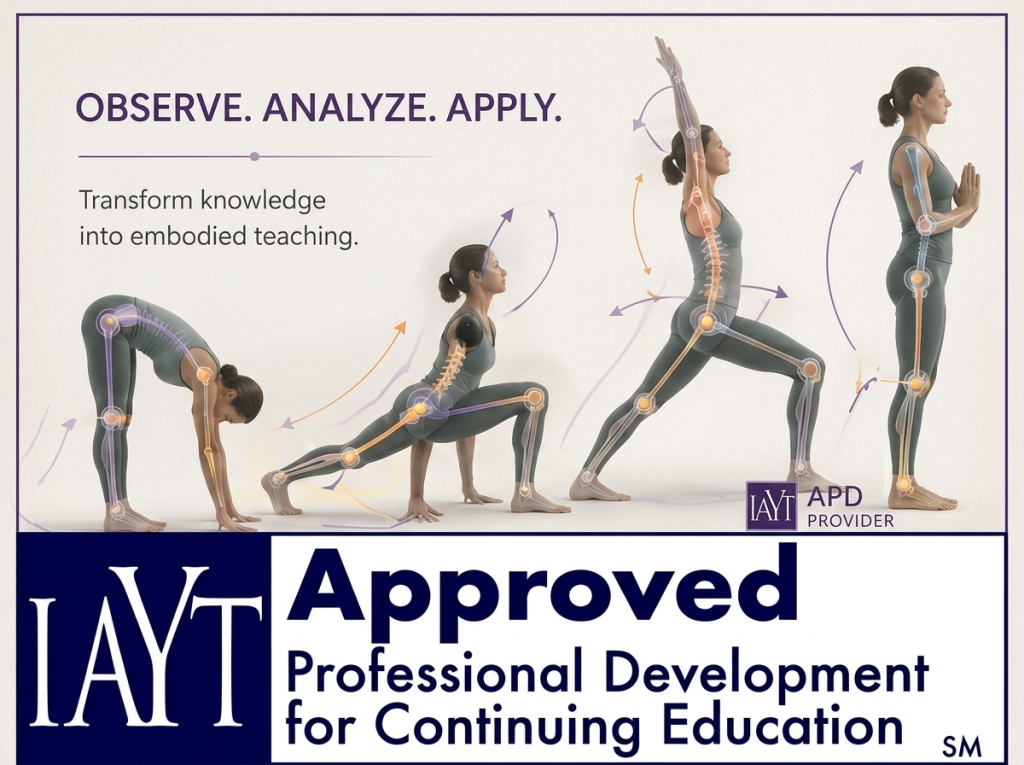
This 15-hour APD course fills that gap. Led by Abha Bajaj (C-IAYT, E-RYT 500, YACEP, ACE Certified PT), it combines structured theory with hands-on laboratory practice in every module, culminating in a dual assessment of both theoretical and practical competency.
You will leave with sharper clinical eyes, a systematic approach to client assessment, and the confidence to justify every therapeutic decision with anatomical and physiological precision.
- Hands-on movement laboratory in every module
- Palpation, biomechanical analysis & partner assessment
- Five-component functional yoga therapy assessment framework
- SOAP documentation and clinical reasoning skills
- Dual assessment: written theory exam + practical clinical exam
- 15 CPD hours toward C-IAYT re-certification
40793452
— What You Will Gain
- Identify key anatomical structures relevant to yoga therapy
- Explain physiological responses to yoga postures and breathwork
- Describe biomechanical principles of joint motion and load
- Understand connective tissue, fascia, and tensegrity models
- Relate anatomical variation to individualised therapeutic planning
- Conduct a functional movement and postural assessment
- Apply biomechanical analysis to yoga posture alignment
- Safely modify practices based on anatomical findings
- Identify contraindications for specific populations
- Complete SOAP documentation with anatomical rationale
- Integrate anatomy into evidence-informed decisions
- Develop biomechanically justified practice rationale
- Apply a client-centred approach for individual anatomy
- Evaluate risk-benefit of yoga for diverse presentations
- Reflect on knowledge to refine professional practice
— Curriculum
Foundations of Anatomy & Physiology for Yoga Therapy 2.5 hours · Theory + Laboratory
- Anatomical terminology: planes, axes, directional terms
- Overview of body systems relevant to yoga therapy
- Musculoskeletal anatomy: bones, joints, cartilage, ligaments
- Muscle physiology: fibre types, motor units, proprioception
- Connective tissue: fascia, tensegrity model, myofascial chains
- Anatomical variation and its clinical implications
- Homeostasis and yoga’s role in physiological regulation
- Palpation practicum: locating bony landmarks on a partner
- Active movement exploration: identifying prime movers
- Fascial tension and range of motion partner exercise
- Postural observation: spinal curves, pelvic tilt, shoulder alignment
- Movement exploration across the three anatomical planes
The Spine & Core: Structure, Function & Therapeutics 2.5 hours · Theory + Laboratory
- Vertebral regions: cervical, thoracic, lumbar, sacral
- Intervertebral disc anatomy, degeneration & clinical relevance
- Core musculature: transversus abdominis, multifidus, pelvic floor, diaphragm
- Intra-abdominal pressure (IAP) and spinal stabilisation
- Spinal curves: hyperlordosis, hyperkyphosis, scoliosis
- Palpation of PSIS, iliac crest, lumbar spinous processes
- Cat-Cow biomechanical analysis in pairs
- Core activation: Plank and Bird-Dog analysis
- Seated forward fold: disc limitation vs hamstring restriction
Upper Extremity Biomechanics2 hours · Theory + Laboratory
- Shoulder girdle: glenohumeral mechanics, rotator cuff, scapular rhythm
- Impingement vs instability: recognition and yoga implications
- Elbow & wrist: carrying angle, wrist load in weight-bearing postures
- Hypermobility: recognition and therapeutic modification
- Shoulder mobility assessment: flexion, abduction, rotation range
- Downward-Facing Dog: scapular position and wrist alignment
- Chaturanga: rotator cuff loading and elbow alignment
Lower Extremity Biomechanics2.5 hours · Theory + Laboratory
- Hip joint anatomy: acetabular depth, femoral version, labrum, FAI
- Knee anatomy: tibiofemoral mechanics, ACL, meniscus loading
- Ankle and foot: dorsiflexion requirements, arches, pronation
- Kinetic chain integration: Warrior series foot to spine
- Hip mobility screening: Thomas Test, FABER, rotation range
- Warrior I & II kinetic chain analysis in pairs
- Knee tracking in Utkatasana: valgus vs neutral alignment
- Single-leg balance: proprioceptive observations
Physiological Systems in Yoga Therapy2.5 hours · Theory + Case Study
- Respiratory physiology: diaphragm, lung volumes, breath regulation
- Pranayama physiology: CO²/O² balance, hyperventilation effects
- Autonomic nervous system and polyvagal theory
- HPA axis: cortisol, stress physiology, yoga’s regulatory effects
- Cardiovascular response to postures and inversions
- Small-group analysis of two client vignettes
- Design a 6-week yoga therapy programme using physiological knowledge
- Present findings in SOAP format with full physiological justification
Clinical Application & Integrated Assessment3 hours · Clinical Lab + Assessment
- Triad format: therapist / client / observer — full 5-component assessment
- Subjective intake, postural observation, movement screen, functional analysis, planning
- SOAP documentation and structured peer feedback
- Part A: Theory written examination — 1 hour (60 marks)
- Part B: Practical clinical examination — 1 hour (60 marks)
- 60% pass mark required in each component independently
Hours Distribution
— Assessment
| Criterion (5 marks) | Distinction (9–10) | Credit (7–8) | Pass (6) | Unsatisfactory (0–5) |
|---|---|---|---|---|
| Anatomical Knowledge | Extensive and accurate; confidently applied throughout | Good knowledge; minor gaps; mostly accurate | Adequate; some gaps; basic application | Significant gaps; inaccurate or absent |
| Assessment Technique | Systematic and professional; all 5 components completed | Good technique; mostly systematic; minor omissions | Adequate; some components incomplete | Unsystematic; significant errors |
| Clinical Reasoning | Sophisticated; anatomy linked to coherent therapeutic plan | Sound reasoning; good anatomical justification | Basic reasoning; some anatomical linkage | Absent, superficial, or incorrect |
| SOAP Documentation | Precise and complete; all sections well-differentiated | Good; minor omissions in content or structure | Basic structure evident; some sections vague | Incomplete; inadequate clinical detail |
— Ideal Participants
Who This Course Is For
Designed for yoga therapy professionals ready to deepen their anatomical and clinical knowledge.
Certified Yoga Therapists (C-IAYT)
Seeking greater precision in client assessment and evidence-informed biomechanical reasoning for therapeutic practice.
Advanced Yoga Therapy Trainees
Enrolled in IAYT-accredited 800+ hour programmes who want to bridge anatomical theory to hands-on clinical practice.
Yoga Teachers Moving into Therapy
E-RYT 500 teachers pursuing yoga therapy credentialing who need a rigorous anatomy and biomechanics foundation.
Allied Health Professionals
Physiotherapists, nurses, or personal trainers integrating yoga therapy into their clinical practice or scope of work.
— Course Format

Didactic Instruction
Facilitator-led seminars using anatomical models, 3D anatomy software, and case vignettes. Spaced retrieval and concept-checking throughout.
Movement Laboratory
Hands-on palpation practicals, partner movement observation, and biomechanical posture analysis in every module.
Case-Based Learning
Small-group analysis of diverse client cases, facilitated using a clinical reasoning framework with SOAP note presentations.
Option A
Option B
— Your Lead Facilitator
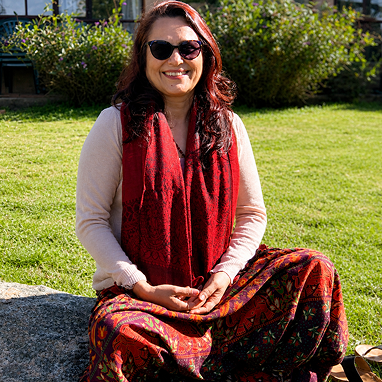
E-RYT 500 · YACEP · ACE PT
Abha Bajaj
Senior Yoga Therapist · Mind Body Symphony, Singapore
— Enrolment
15 contact hours · Singapore · In-person
What’s Included
- All 6 modules — theory and hands-on laboratory
- Facilitator course materials and resource pack
- Theory assessment (written examination)
- Practical assessment (clinical examination)
- One re-assessment attempt within 30 days if needed
- IAYT Certificate of Completion (15 CPD hours)
- 2-day intensive or 5 × 3-hour session formats available
- Certificate issued upon passing both assessments
- 15 CPD hours applicable to C-IAYT re-certification
- Aabhabajaj@gmail.com
- WhatsApp: +65 9829 7361
- mindbodysymphony.org
Enquire or Enrol
Ready to invest
in your wellbeing?
Your path to feeling better starts with a single conversation. If you feel drawn to explore this path, you are welcome to begin at your own pace.